

caring@home resource boxes
Use our guides, checklists, videos and other resources to support people providing palliative care at home.
You can order a Community Palliative Care Resources Box, or access tailored, downloadable resources. Select an option below to learn more and access the resources.
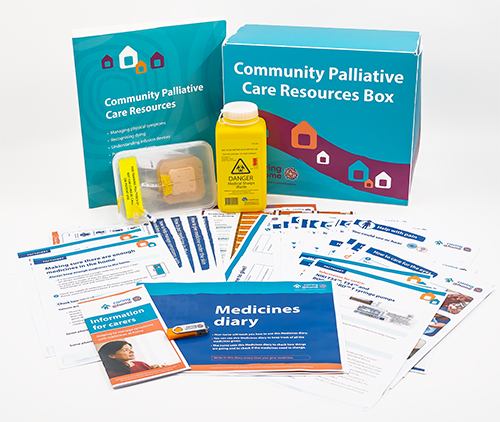
caring@home resources matrixUse our matrix to help you choose the resources that best suit your patients and their carers or families. You can also download the matrix for a detailed breakdown and description of each resource. |
|
|
| ||
Palliative Care Clinic Box | |||||
| English | Translated | ||||
| Managing physical symptoms | Tip sheets | ||||
| Recognising dying | Tip sheet | ||||
| Understanding infusion devices | Factsheets | ||||
| Providing practical care | Practical care step-by-step guides and videos | ||||
| Managing subcutaneous medicines | Information brochure | ||||
| Managing medicines factsheets | |||||
| Practical handbook for carers | |||||
| Medicines diary/book | |||||
| Wall/fridge chart | |||||
| Syringe labels | |||||
| Step-by-step guides and videos | |||||
| Training checklist | |||||
Order a box
Clinical services can order one resource box per site.
Note: The order form for all states and territories (except Queensland) is managed through the Redcap secure database management system.
Frequently asked questions: Using the caring@home resources
If the carer decides to take on this role, a nurse will need to provide one-on-one training to teach them what they need to know. The most important are the online education modules for registered nurses and for Aboriginal Health Workers.
Nurses can find resources to support them to teach carers to help manage symptoms under the Support for carers and families tab on the caring@home website including Resources for Aboriginal and Torres Strait Islander families and Translated resources. Clinical judgement is necessary to determine which resources are most appropriate for the individual learning needs of each carer.
These resources can be given to families and carers as hard copies that they can keep in the home, emailed to them, or they can access them via the caring@home resource apps.
A carer who has been trained to help manage breakthrough symptoms by using subcutaneous medicines requires access to 24-hour medical support from a medical professional.
Teaching carers requires an initial time commitment of 30 to 60 minutes. The exact time needed will vary depending on individual circumstances, but this investment often saves time later – as well-prepared carers typically require fewer phone calls and call-outs.
The role of giving subcutaneous medicines is voluntary. Nurses should clearly communicate this to carers and emphasise that they can stop at any time. The caring@home Information for Carers brochure is a helpful resource to support this conversation.
Conversations about giving subcutaneous medicines to help manage breakthrough symptoms should not occur in isolation. Instead, nurses – using their clinical judgement – should have these iterative conversations in the context of the preparatory discussions they are already having about recognising clinical changes and deterioration in patients who are dying.
Patients and families can become very distressed if symptoms are not managed in a timely manner. If a patient and carer are waiting for a 24-hour service to arrive, there is a risk that the patient will remain in distress until support is available.
Some services report that after-hours response times can be lengthy, which may lead to increased distress for both patients and carers. In addition, many patients and carers may not have access to a 24-hour home visiting service at all.
For patient safety and carer confidence, the caring@home resources must only be used by services that offer a 24-hour on-call phone number. This ensures carers can access appropriate clinical advice about managing subcutaneous medicines when needed.
Focus group interviews with carers who used the resources found that they valued the reassurance of having a 24-hour contact number – even if they didn’t end up using it.
The Guidelines for the Handling of Palliative Medicines in Community Services can be used by clinical services to inform the development of protocols and procedures tailored to their specific needs. These guidelines are applicable across all jurisdictions in Australia.
How you can support your patients and their carers
Everyone in your patient’s health care team has an important role.
Nurses
Nurses will use the caring@home resources to teach carers and family how to provide practical care and give subcutaneous medicines. They’ll also give them a 24-hour phone number to ring if they’re worried or need advice.
Doctors, nurse practitioners and nurse prescribers
Doctors, nurse practitioners and nurse prescribers will prescribe the medicines used to treat breakthrough symptoms.
Pharmacists
Pharmacists will provide any prescribed medicines and make sure carers and family understand what they are and answer questions they have.
Our online education modules have more information about our resources and how to use them.