

About the PELP Framework™
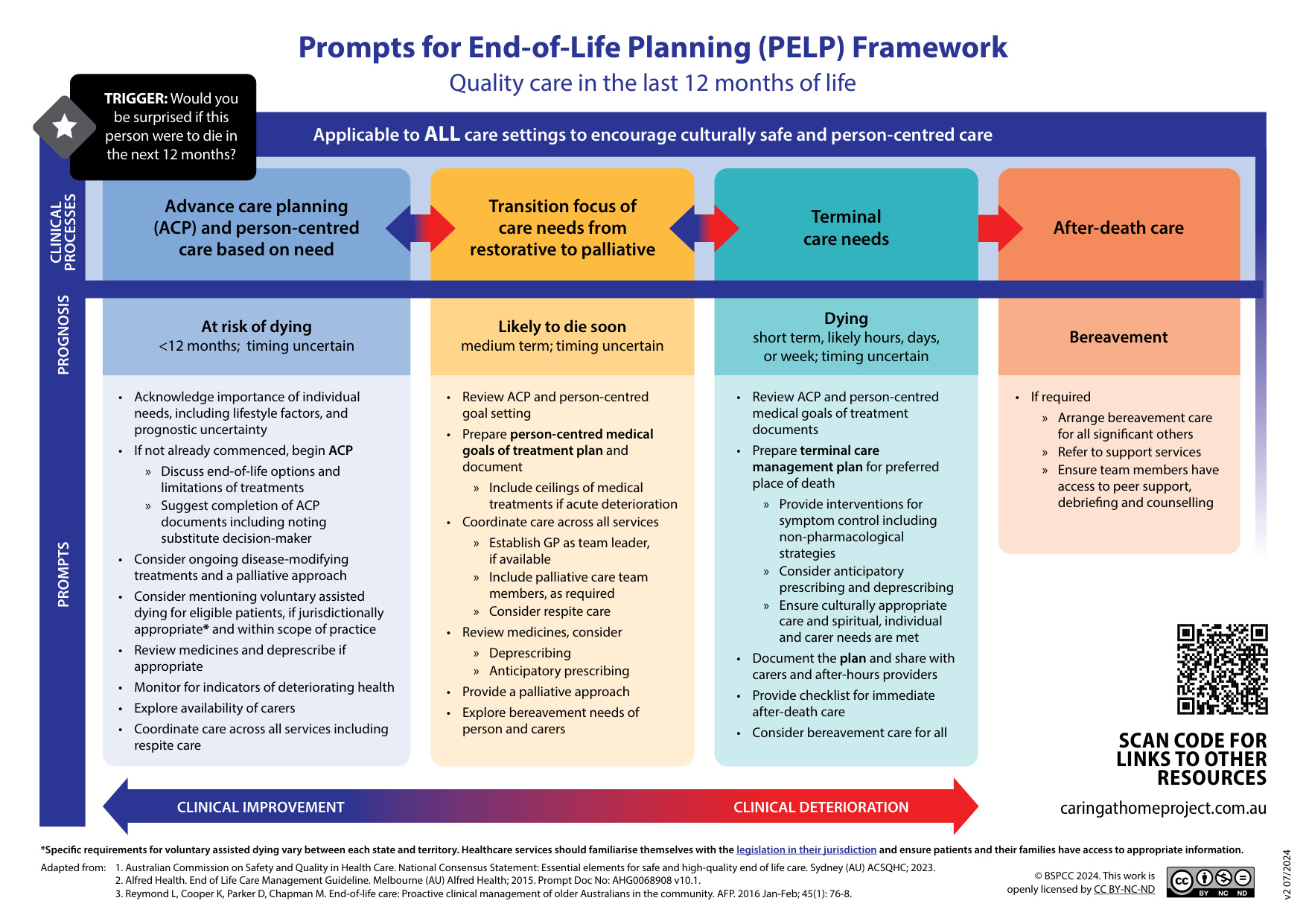
The Prompts for End-of-Life Planning (PELP) Framework™ (formerly known as The Palliative and End-Of-Life Care Framework – Last 12 Months of Life) guides proactive, quality end-of-life care across all care settings.
The PELP Framework™ contains prompts that support:
- Identification of patients suitable for a palliative approach to care:
- Ask the surprise question: ‘Would you be surprised if the person died in the next twelve months? This can be answered by intuition , using clinical and personal knowledge of the patient, and/or clinical tools (e.g. SPICT).
- Identification of four clinical end-of-life processes:
- Advance care planning and person-centred care based on need (at risk of dying)
- Transition focus of care needs from restorative to palliative (likely to die soon)
- Terminal care needs (dying)
- After-death care (bereavement).
The PELP Framework™
Resources supporting the PELP Framework™
- GP CPD Activity: End-of-life planning mini audit and FastTrack CPD: discover three new education activities to support confidence in delivering community-based palliative care.
- Audit tool: End-of-Life Planning: supports quality improvement in caring for patients likely to be in the last year of life.
- Terminal care planning checklist for nurses in the community: identifies actions required to prepare care for a person at home in their final hours, days or week.
- Terminal care planning checklist for General Practice: provides a checklist to assist GPs to prepare a terminal management care plan to guide the care for a person at home in their final hours, days, or week.
- Terminal Care Management Plan template: GPs can use this template (for Medical Director or Best Practice software) to develop a terminal care management plan for patients who are expected to die in the next few weeks.
When to use it
Implementation of the PELP Framework™ helps health professionals deliver quality person-centred care in the last 12 months of life.
It encourages identifying patients at risk of deteriorating and dying, prompting meaningful conversations about their care goals and preferences. These ongoing discussions help create person centred management plans that reflect the person's wishes and reduce making difficult decisions during emotional times.
How the PELP Framework™ was developed
The framework was recently reviewed by a national advisory committee of GPs, palliative medicine specialists, nurse practitioners and nurses from the following organisations:
- Australian College of Nurse Practitioners (ACNP)
- Australia New Zealand Society of Palliative Medicine (ANZSPM)
- Blue Care - Queensland
- Brisbane South Primary Health Network (BSPHN)
- Consumer representative
- Northern Territory Primary Health Network (NTPHN)
- Rural Doctors Association South Australia (RDASA)
- The Royal Australian College of General Practitioners (RACGP)
caring@home resources
| Topic | Title | Description |
|---|---|---|
| Quality improvement | Audit tool: End-of-Life Planning | The purpose of the Audit tool: End-of-Life Planning is to support quality improvement in caring for patients likely to be in their last year of life. |
| Terminal care planning 3 | Terminal care planning checklist for nurses in the community | The Terminal care planning checklist for nurses in the community assists nurses providing care to a person at home in their final hours, days, or week. It aligns with the terminal care management clinical process as described in the PELP Framework. |
SPICTTM | Supportive and Palliative Care Indicators Tool (SPICTTM) helps identify people with deteriorating health due to advanced conditions or serious illness. | |
| palliMEDS app | The palliMEDS app supports primary care prescribers to provide optimal symptom management to their patients in the community. palliMEDS has prescribing information about palliative care medicines identified by clinicians across Australia as the most useful to manage common symptoms in home-based palliative care patients in the last few weeks of life. | |
| National Core Community Palliative Care Medicines List | The National Core Community Palliative Care Medicines List identifies four medicines for use by home-based palliative patients in the terminal phase who require urgent symptom relief. |
Supporting resources
| Topic | Title | Description |
|---|---|---|
CareSearchgp App | The CareSearchgp App offers palliative care information and prescribing guidance to support quality care at end of life | |
ACPATM | Advance Care Planning AustraliaTM is a national project enabling Australians to make the best choices for their future health and care. Learn about the process for creating an advance care plan in your state. | |
| QUT End of Life Law in Australia | This webpage discusses the laws on Voluntary Assisted Dying (VAD) both in Australia and internationally, and their intersection with palliative care and medical treatment decision-making. | |
| Gather My Crew app | Set up a 'support crew' with the free Gather My Crew app to coordinate family and friends to help with meals, laundry, grocery pickup or social visits. | |
| PEPA and iPEPA | PEPA Education provides free health placements in palliative care services and free palliative approach workshops. | |
| Australian Commission on Safety and Quality in Health Care | Identifying goals of care: Tips for clinicians - a Comprehensive Care Standard | |
| Services Australia |
Outlines helpful resources that can be used to support the clinical processes of the PELP Framework
1 Advance Care Planning (ACP) and person-centred care based on need
2 Transition focus of care needs from restorative to palliative
3 Terminal care needs
4 After death care
Suggested citation
Brisbane South Palliative Care Collaborative. Prompts for End-of-Life Planning (PELP) Framework™. Version 2. Brisbane; 2024. Available from: https://www.caringathomeproject.com.au/__data/assets/pdf_file/0016/340009/caring@home-PELP-Framework.pdf.